The New Era of AI: From Passive Assistants to 'Agentic LLM' Autonomous Workers ????
Over the past year, we have been amazed by the capabilities of Large Language Models (LLMs) like ChatGPT, Gemini, or Claude in answering questions, writing articles, or helping with brainstorming. However, the limitation of traditional LLMs is that they act merely as "Passive Assistants" that only respond when prompted and handle tasks one command at a time.
Today, the IT industry is moving toward the next stage of evolution: Agentic LLMs (or AI Agents). This shift transforms AI into "Autonomous Agents" capable of thinking, planning, and executing complex, high-level tasks on their own, without requiring humans to dictate every single step.
What is an Agentic LLM?
If a traditional LLM is like a "walking encyclopedia" that answers questions when asked, an Agentic LLM is like a "company employee." When given a high-level goal, it can break that goal down into strategies, create step-by-step plans, select the right tools, and work autonomously until the goal is achieved.
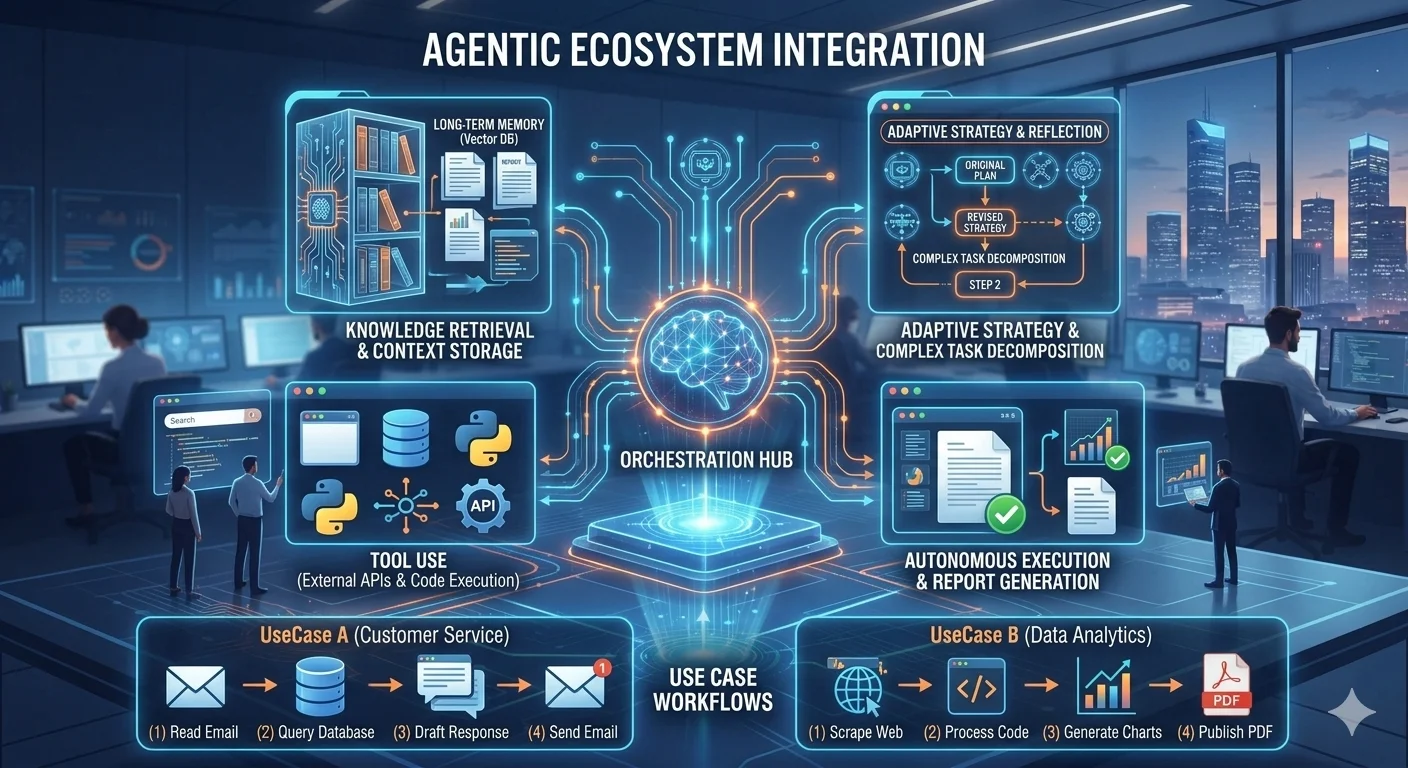
The core architecture that enables an LLM to function agentically consists of four main pillars:
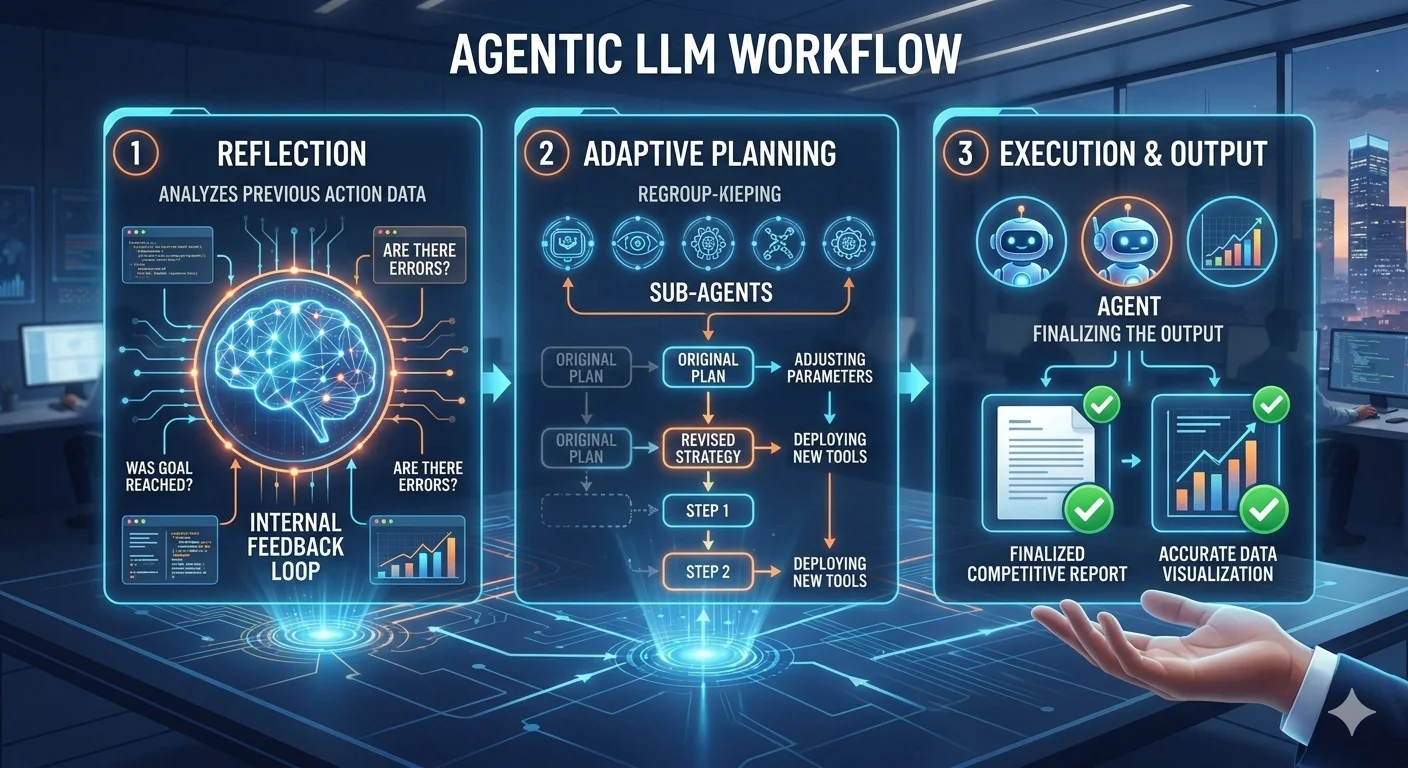
- Planning: The AI can break large, complex problems down into smaller sub-tasks. It uses reflection to analyze whether its actions are correct and can dynamically adjust its workflow if it encounters errors.
- Memory: It possesses short-term memory to maintain the context of the current task, and long-term memory via Vector Databases to retrieve past information for future use.
- Tool Use: The AI is no longer confined to a chat box. It can call APIs, search the internet, write and execute Python code, or control external software to get the job done.
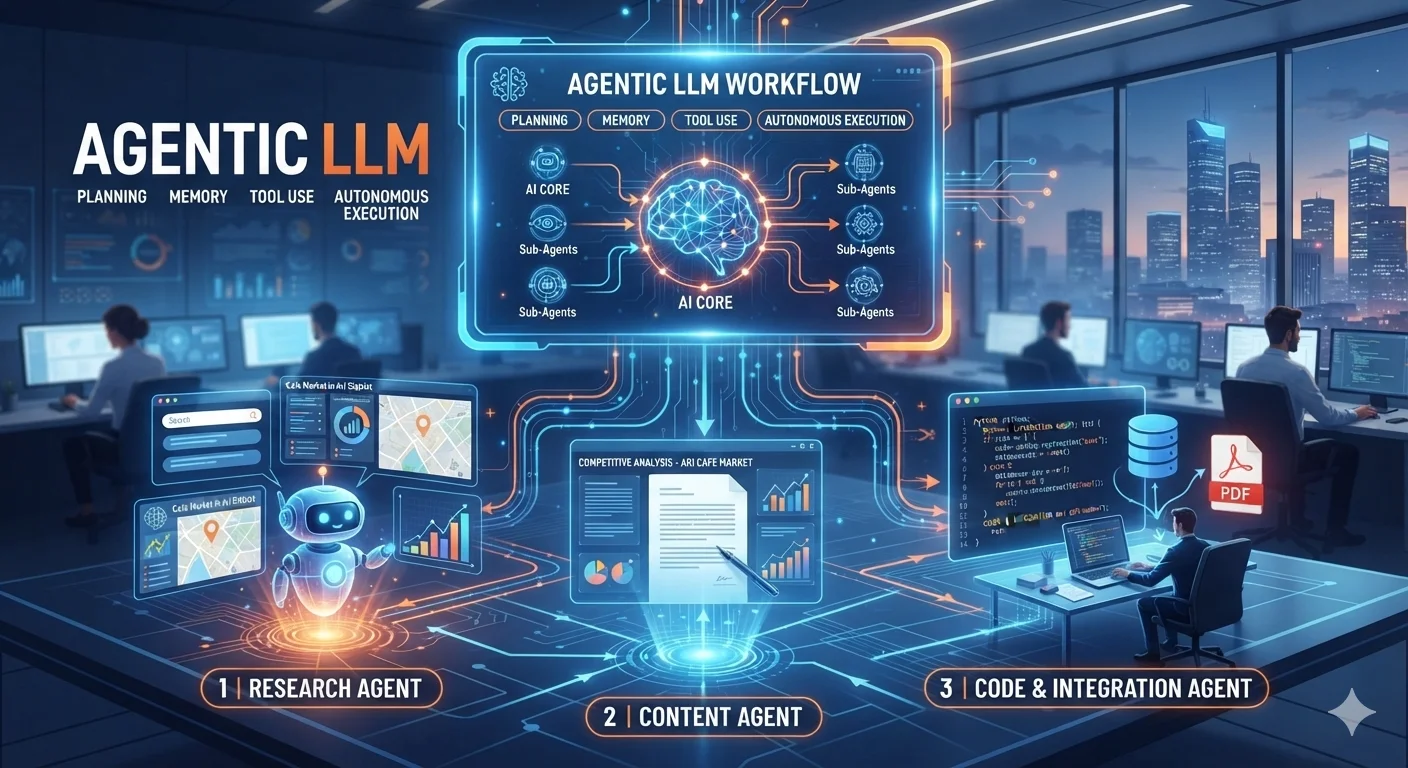
- Multi-Agent Systems: For highly complex workflows, multiple specialized agents can be deployed (e.g., an analyst agent, a writer agent, and a code reviewer agent). They can collaborate as a team, passing tasks back and forth until completion.
A Real-World Example of Agentic LLM in Action
To visualize this, let’s compare a traditional prompt workflow with an Agentic AI workflow:
- Task: "Analyze competitors in the cafe market around the Ari neighborhood, and generate a summary report with a price comparison chart."
- Traditional LLM: You must search for the competitor data yourself and feed it to the AI, or ask the AI to search for it. Then, you have to copy that data and prompt the AI to plot a chart, followed by another prompt to format the report step by step.
- Agentic LLM: You input this command just once. The AI Agent automatically searches for coffee shops in the Ari area via Google Maps, extracts menu and price details from customer reviews, writes code to plot the chart, saves it as an image, verifies data accuracy, and compiles everything into a professionally formatted PDF report delivered in a single workflow.
Why Agentic LLMs are a Business Game Changer
The arrival of Agentic AI marks a transition from increasing personal productivity to driving true workflow automation across enterprises:
- Automating Complex, Repetitive Workflows: Tasks like screening customer emails, categorizing them, verifying details in a CRM system, and drafting personalized replies can now be handled end-to-end by an AI Agent.
- 24/7 Precision Monitoring: AI systems can be set to continuously monitor marketing data or IT security infrastructure. If an anomaly is detected, the AI can analyze the root cause and execute initial troubleshooting steps immediately.
- Lowering the Software Learning Curve: In the future, we may no longer need to learn how to operate complex accounting or video editing software. We will simply tell the AI Agent our goal, and it will click the buttons, issue commands, and operate the software on our behalf.
Challenges to Overcome
Despite their immense potential, Agentic LLMs still face significant hurdles. These include infinite loops (where the AI gets stuck in a thinking cycle without finding a solution), hallucinations (where the AI invents false information and passes it to external tools, causing errors down the line), and AI safety/governance, which requires strict boundaries and permission controls to prevent the AI from accidentally deleting critical data or executing unauthorized transactions.
Conclusion
Agentic LLMs represent a massive leap forward, bringing us one step closer to Artificial General Intelligence (AGI). Today, AI is no longer just a tool we "chat" with, but a "co-worker" capable of making decisions and executing tasks for us. Learning how to architect systems, design agentic prompts, and supervise these AI agents will undoubtedly become one of the most critical tech skills of this era.